


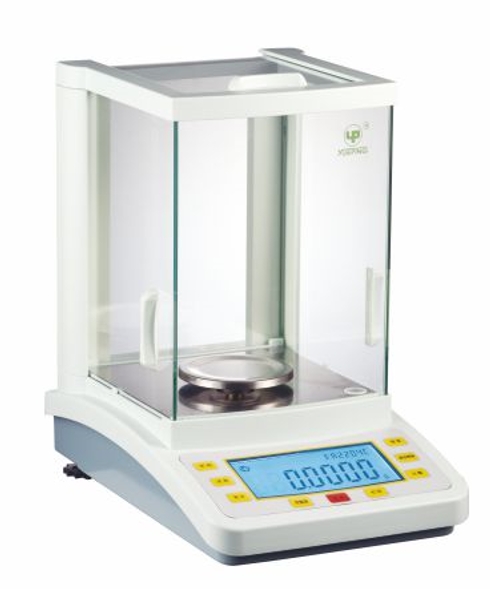
AUTOMATICITY INSIDE CAL ELECTRONIC ANALYZE BALANCE
Model: FA604C
Weighing Range: 0-60g
Readable Precision: 0.1mg
Scale Size: Φ90mm
Net weight: 6.8kg
Outline dimension: 350×215×340mm
Out packing dimension: 480×375×515mm
The height of working space: 240mm
CAL: Internal Calibration
Advanced weight-loading mechanism is addedinside the balance,so taht the balance has function of antomatic built-in weight calibration;service performance and weighing precision are greatly improved.This product is pioneering in the field of domestic balance industry.
Feature:
● Humanized desogn,novel design and five-side full-transparent windshield.A new-generation electromagnetic balance weughting sensor guarantees high precision.Application programs such as sutpmatic fault detection,four-point linear calibration and over-load protection.
● The adoption of ultra-large digital intergrated printed circuit board guarantees high product precision.Th adoption of twin-cam mechanism realizes advantafeous funcation of automatic internal calibration which makes product faster and more stable.
● Application programs such as "warming","calibrating"and screen saver.
● Ultra-large backlight LCD display brings clearer and more comfortable visual senso to operator.
Function:
● Multip functions guaranteee easy and reliable operation,including auto-counting,unit conversion(metric carat,gole ounce,etc,),stablility,full-scale faring,zero-memory,etc
● Built-in automatic ablibration guarantees easier,faster,stable and accurate operation of the balance.
● Bilit-in RS232C output interface guarantees direct connection to external equipemnt such ascomputer and printer
● Built-in lower weighing hook guarantees convenient use.
FAQ
Q1: What precision analytical balance is required for melt flow rate testing and carbon black content testing, respectively?
For melt flow rate (MFR) testing, the weighed material is the cut melt extrudate, with each segment typically weighing between 0.01–0.5 g. An analytical balance with 0.1 mg (1/10,000) precision is recommended, with a capacity of 60–220 g being sufficient.
For carbon black content testing (by ignition loss method), the balance is used to weigh the sample and crucible before and after heating to calculate the percentage difference. A precision of 0.1 mg (1/10,000) is also recommended.
Q2: What balance capacity is appropriate?
Melt flow rate testing: The mass of a single extrudate segment is very small, so a capacity of 60 g or 100 g is more than adequate.
Carbon black content testing: The crucible plus sample needs to be weighed. The crucible itself weighs about 20 g, so a capacity of 60 g or above is recommended to avoid overloading. If one balance is to be used for both tests, a 60 g / 0.1 mg model is the most versatile choice.
Q3: How to choose between internal calibration and external calibration?
External calibration balances: Lower cost, but require manual calibration with standard weights on a regular basis. Suitable for laboratories with dedicated personnel and relatively low usage frequency.
Internal calibration balances: Built-in calibration weights with one button automatic calibration, offering convenience and more stable data. Ideal for quality control laboratories with high usage frequency and high requirements for data consistency.
Product Inquiry