



How We Helped a Customer Cut R&D Time by 30% with a Testing Machine – Our Carbon Fiber Testing Story with a New Energy Vehicle Manufacturer
Last spring, our sales manager, Lao Chen, received an urgent call. Zhang Gong, from the Materials R&D Department of a leading domestic new energy vehicle manufacturer, sounded very anxious: "We've developed three new versions of our carbon fiber composite formula for the car body, but every time we test it, the data is erratic. The project has already been delayed by two months. If we can't solve this soon, this year's mass production plan will have to be postponed." It turned out they were stuck.
Zhang Gong and his team had a clear goal: replace traditional steel with carbon fiber composites to reduce the car body's weight by 15%, thereby increasing the driving range. This was the core selling point of their new model. But no matter how they tested, something was off:
- Using their old equipment on the same batch of samples gave five different results, with data deviations up to 2%. The R&D team simply couldn't make decisions based on such unreliable data.
- Carbon fiber composites fail through progressive cracking. The old equipment had a slow sampling rate and couldn't capture the intermediate damage process. They only knew when it finally broke, not why.
- The biggest headache was clamping the samples. They would slip during tension, and sometimes the fixture would loosen before the sample even broke, wasting a lot of time. The lab technicians were getting exhausted.
To be fair, this wasn't their fault. Many people working on new material R&D have encountered this issue: the equipment parameters might look similar on paper, but when it comes to high-precision testing, small differences matter a lot.
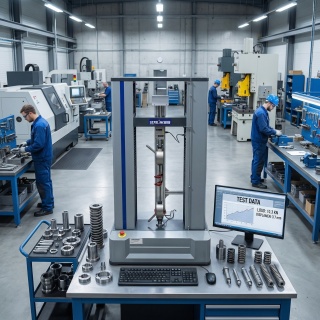
Our custom solution actually changed only two things:
After listening to Zhang Gong's requirements, we provided them with a 50kN computer-controlled electronic universal testing machine, making two specific adjustments for carbon fiber testing:
1) Custom pneumatic tension grips. Ordinary flat grips couldn't hold the smooth carbon fiber samples, causing slippage. This problem was solved immediately. Test deviation for samples from the same batch was controlled within 0.3%, providing much more stable data.
2) Sampling frequency upgraded to 10,000 Hz. The old equipment only collected 100 points per second, missing the entire crack propagation process. With 10,000 samples per second, the complete failure process curve was fully recorded, allowing R&D to see every step of the change. The results turned out even better than we expected.
The next day after the equipment arrived, our engineer performed the first test on-site. They prepared three different carbon fiber content samples, with five parallel specimens for each type. From clamping to report generation, everything was completed in less than two hours.
Zhang Gong and his team stared at the curves on the screen for a long time. The sample with 50% content showed its first damage at 1.2% elongation – a point their old equipment had never detected! With this precise data, they quickly adjusted the formula to achieve 55% carbon fiber content. Not only did the tensile strength reach 2,350 MPa, meeting the body strength requirements, but the weight was reduced by an additional 3% compared to the original plan, exceeding their performance target.
The tangible benefits the customer ultimately received
During project acceptance, Zhang Gong told us this machine had been a huge help:
1. R&D became significantly faster: What used to take a week of testing without conclusions now produced a reliable set of data in just two days. The entire formula R&D cycle was shortened by 30%, and the project met the original mass production schedule.
2. No more worries about quality issues: Every batch of incoming carbon fiber raw material can now be quickly spot-tested. Unqualified materials are rejected at the door, preventing production delays caused by unstable material properties.
3. Significant cost savings: After formula optimization, carbon fiber usage was reduced by 10%, lowering material costs per vehicle by 8%. This saves over 10 million yuan annually in raw material costs alone.
Zhang Gong joked, "I used to think a testing machine was just a 'data output tool.' Now I realize that whether the data is accurate or not directly determines whether a project lives or dies."
What we really care about is solving real problems for our customers
After so many years of building electronic universal testing machines, we understand one thing well: pain points differ greatly across industries. Construction materials need to test rebar strength for safety. Medical devices need to test implant performance to save lives. New energy needs to test new materials to accelerate development. Many small manufacturers compete only on price, listing impressive specifications, but their equipment is full of problems in actual use.
Our equipment has always adhered to these principles, learned through helping customers test:
Today, our electronic universal testing machines are deeply embedded in dozens of industries – automotive, aerospace, construction, medical, and more – helping over 500 customers solve testing challenges from R&D to production. If you're also facing material testing problems like "inaccurate data causing delays," feel free to reach out to us. Perhaps the right machine could help push your stuck project significantly forward.