


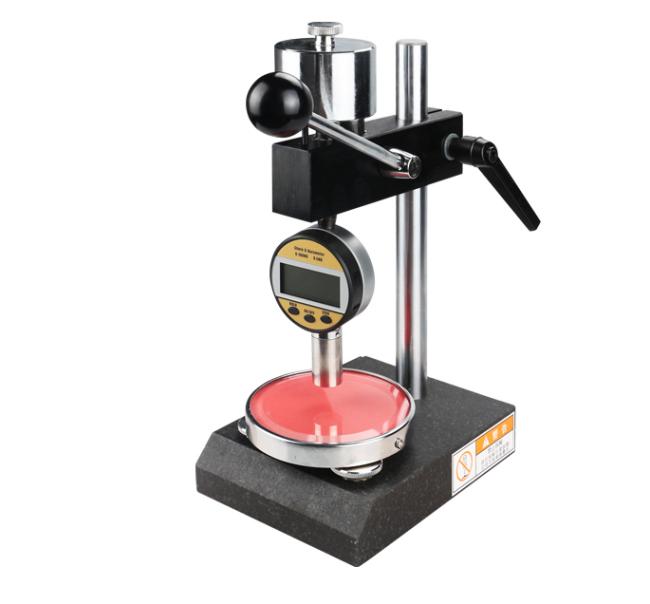
LX-A Digital Rubber Hardness Tester
Model: LX-A
Measurement Range: 0-100 HA
Measurement Error: Within the range of 20-90 HA, the error is ≤ ±1 HA
Resolution: 0.1 HA
Indenter Travel: 0-2.5 mm
Force at Indenter Tip: 0.55 N - 8.05 N
Standards: ASTM D 2240
Shore Hardness Tester: Type A vs Type D – What's the Difference?
Shore A and Shore D are the two most commonly used durometer scales for measuring the hardness of rubber and plastics. They share the same testing principle – pressing a standardized indenter into the material under a specific force and converting the indentation depth into a hardness value from 0 to 100. The difference lies in indenter geometry, applied force, and intended materials.
Parameter | Shore A (LX-A) | Shore D (LX-D) |
Indenter tip | Blunt cone, ø0.79 mm (rounded) | Sharp cone, R0.1 mm (pointed) |
Test force range | 0.55 N – 8.06 N | 0.455 N – 44.5 N |
Ideal hardness range | 10 – 90 HA | 20 – 90 HD |
Typical materials | Soft rubber, elastomers, TPE, seals, gaskets, leather, felt | Hard rubber, rigid plastics, thermoplastics, epoxy, acrylic, printed circuit boards |
Common standards | GB/T 531, ASTM D2240 Type A | GB/T 531, ASTM D2240 Type D |
Use case | General rubber products, flexible seals, O-rings | Engineering plastics, hard resin, floor materials |
·Use Shore A for soft to medium-hard rubber and elastic materials.
·Use Shore D for hard rubber and rigid plastics.
·Rule of thumb: If a reading exceeds 90 HA, switch to Shore D for more accurate results. If it falls below 20 HD, switch back to Shore A. Measurements near the extremes of a scale are less reliable.
FAQ – Frequently Asked Questions
Q1: What is a Shore hardness tester used for?
A Shore hardness tester measures the indentation hardness of vulcanized rubber, thermoplastic rubber, and plastics. It is widely used in quality control, material testing labs, and on-site production inspection.
Q2: What's the difference between Shore A, Shore C, and Shore D?
All three work on the same principle but use different indenter shapes and forces:
·Shore A – blunt cone tip, for soft rubber and elastomers
·Shore C – 5 mm spherical tip, for foam and sponge materials
·Shore D – sharp cone tip, for hard rubber and rigid plastics
Q3: How do I choose between Type A and Type D?
Start with Shore A for most rubber and flexible materials. If your reading is above 90 HA, the material is too hard for the A scale – switch to Shore D. Conversely, if a Shore D reading is below 20 HD, go back to Shore A for better accuracy.
Q4: Do I need a test stand or is handheld measurement okay?
Handheld testing works for quick on-site checks and large installed components. For standardized laboratory measurements or quality certification, a dedicated test stand is required to ensure consistent force application and accurate, repeatable results.
Q5: How should I prepare the sample?
·The specimen surface must be clean, smooth, and free of oil, dirt, or oxidation.
·Sample thickness should be at least 6 mm (thin samples can be stacked).
·Test at ambient temperature (20°C ± 10°C) and away from vibration.
·Take at least 3 measurements at different points and average the results.
Q6: How often should I calibrate the hardness tester?
Calibrate with a standard hardness block before each use, or at least once per shift during continuous operation. Formal metrological calibration should be performed annually or according to your quality management system requirements.
Q7: Why do my readings vary between tests?
Common causes include:
·Inconsistent pressure or tilt angle during handheld testing
·Testing too close to the sample edge (stay at least 12 mm from edges)
·Insufficient sample thickness
·Temperature differences between tests
·Surface roughness or uneven material
Using a test stand eliminates most operator-induced variation.
Q8: What standards do Shore hardness testers comply with?
Common standards include GB/T 531 (China), ASTM D2240 (USA), ISO 7619 (international), DIN 53505 (Germany), and JJG 304 (metrological verification regulation of China).
Q9: What's the difference between analog and digital Shore hardness testers?
Analog (dial) testers are simple, durable, and low-cost. Digital testers offer clearer readings, data hold function, memory storage, and PC connectivity for data logging – ideal for batch testing and quality documentation.
Product Inquiry